
Brow Lift vs. Blepharoplasty: Is Your Eyelid Hooding Coming From Your Brow or Your Eyelid?
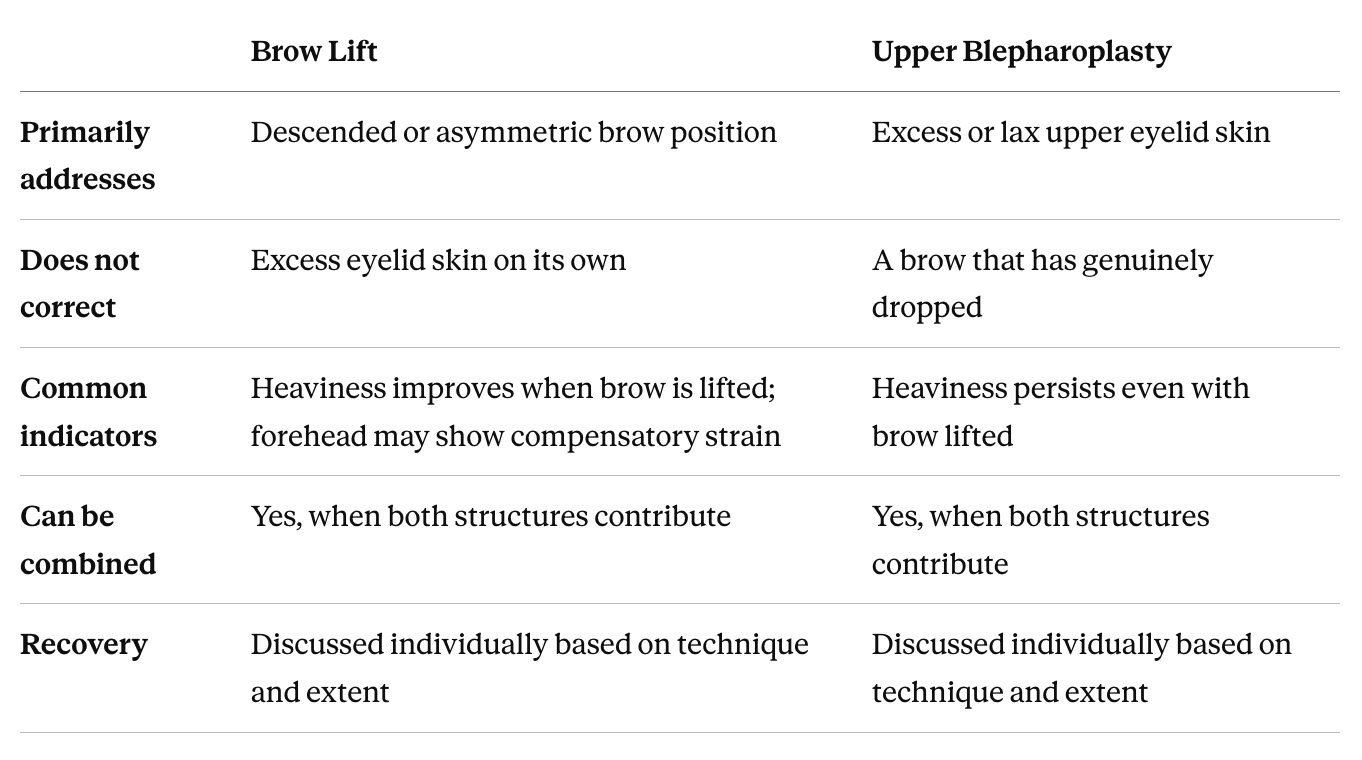
Hooding over the upper eyelid usually comes from one of two places: excess or lax upper eyelid skin, or a brow that has gradually descended over time. Many patients have some degree of both, which is exactly why the two get confused so often. Upper blepharoplasty addresses the eyelid itself. A brow lift addresses the position of the brow. Because these structures sit right next to each other, it's genuinely difficult to tell them apart just by looking in the mirror and the right answer depends on your individual anatomy, not on which procedure is more familiar or more commonly advertised. Identifying which structure is responsible is one of the first steps in any aesthetic consultation with Dr. Jennifer Burgoyne, a board-certified ophthalmologist who has practiced surgical eye care in the Wichita area since 2001.
How do I know if my hooding is coming from my brow or my eyelid?
A simple at home check can offer a clue: gently place a finger under each brow and lift. If the hooding largely disappears, brow position may be the primary factor. If heaviness remains even while holding the brow up, excess eyelid skin or a weakened eyelid muscle is more likely contributing. This test is a starting point, not a diagnosis. The American Academy of Ophthalmology notes that eyelid drooping can stem from the skin, the muscle that lifts the lid, or the brow itself which is why an in person evaluation accounts for muscle function, symmetry, and skin quality in ways a mirror test can't.
What's the difference between a brow lift and blepharoplasty?
A brow lift repositions the brow and forehead tissue to correct a brow that has dropped or become asymmetric. Upper blepharoplasty removes or repositions excess skin and when appropriate, fat from the eyelid itself without changing where the brow sits. Choosing between them, or combining them, depends on which structure is actually responsible for the hooding.
Can Botox help hooded eyes, or make them worse?
Neuromodulators like Botox relax specific muscles; they don't remove excess skin or lift a descended brow. In some patients, Botox placed near the forehead can even reduce the compensatory muscle lift the forehead was using to hold the brow up, which can make hooding feel heavier rather than better. This is a common point of confusion and is worth discussing directly with a provider who evaluates both eyelid and brow anatomy, not just the injection site.
What does a surgeon look for before recommending blepharoplasty?
According to ASOPRS's periocular anatomy guidance, a thorough evaluation weighs several structures together rather than the eyelid in isolation: how much upper eyelid skin is present, where the brow currently sits, whether the forehead muscles are compensating for brow position, whether the eyelid margin itself is drooping (a separate condition called ptosis), and how these factors affect both appearance and, in some cases, peripheral vision. Because BE Aesthetics is led by a surgical eye specialist, this evaluation draws on eye area anatomy training that a purely cosmetic focused provider may not apply in the same way.
Am I a candidate for upper eyelid surgery or a brow lift?
Candidacy depends on your anatomy, your goals, and your overall health, and it isn't something a blog post can determine for you. Some patients are better suited to blepharoplasty alone, some to a brow lift alone, and some benefit from addressing both. For patients in Wichita and the surrounding South Central Kansas area, scheduling an eyelid and brow consultation is the appropriate next step to get an individualized answer rather than guessing based on what a procedure is called.
Making an informed next step
Understanding whether your hooding originates from your brow, your eyelid, or both puts you in a better position to ask the right questions during a consultation and to avoid a treatment that addresses the wrong structure. If you're trying to figure out which concern applies to you, scheduling an eyelid and brow consultation at BE Aesthetics is the most direct way to get clarity.
Frequently Asked Questions
Can I have a brow lift and blepharoplasty at the same time?
In some patients, yes — when both brow position and eyelid skin are contributing to hooding, a surgeon may recommend addressing both during the same procedure or in a staged approach, depending on individual anatomy.
Is a non-surgical brow lift possible?
Some non-surgical options can create a modest, temporary change in brow position for certain patients, but they don't replace surgery when the brow has significantly descended. Whether this is appropriate depends on the degree of change needed.
What happens if I get Botox but my hooding is actually a skin or brow issue?
Botox may have little to no visible effect on the hooding itself, since it doesn't remove skin or reposition the brow. In some cases it can make the area feel heavier, which is why identifying the underlying cause first matters.
Can hooded eyes be caused by both my brow and my eyelid at once?
Yes. It's common for brow position and eyelid skin to both contribute to varying degrees, which is one reason a combined evaluation is more useful than assuming one cause.
How long does recovery take?
Recovery differs by procedure, technique, and the individual, and is best discussed in detail during a consultation rather than generalized here.
Does insurance ever cover blepharoplasty?
In some cases, when excess eyelid skin significantly affects vision, functional criteria may apply. Coverage depends on individual circumstances and the insurer, and should be confirmed directly during the evaluation process.